


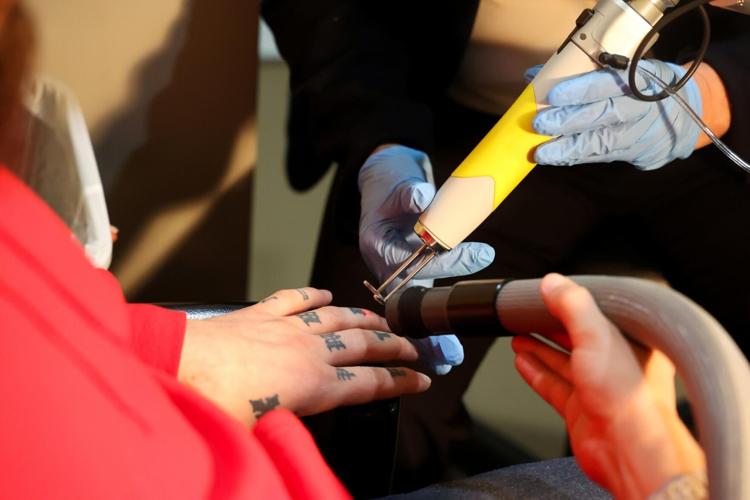
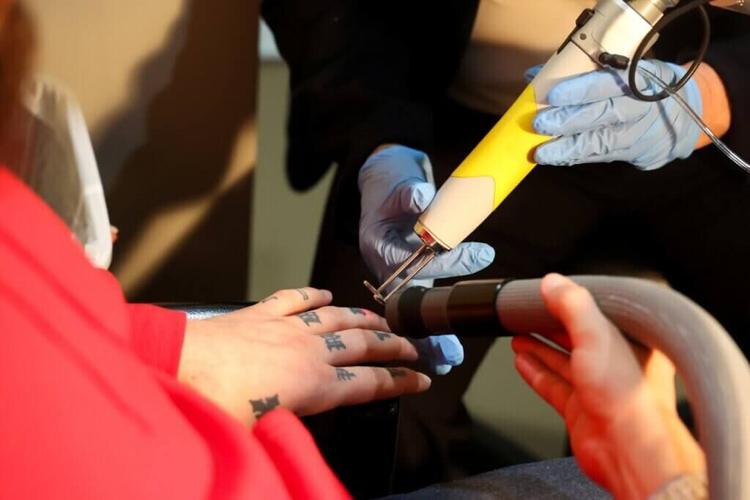
Having a visible tattoo with a vulgar, anti-police message would be a major challenge for someone seeking a job after being incarcerated. Yet that was the future facing a young man at the Community Corrections Center in Lincoln. He was concerned that a spur-of-the-moment decision to get the tattoo would have lasting consequences on his employability.
“I was drinking at the time, and I did it out of impulse,” he said in a sheepish voice. “Now, I regret it.”
“It’s not something that’s meant to be there,” he continued. “I want to grow out of that lifestyle, [to have] a better image.”
That desire motivated him to travel from Lincoln to Omaha with his sponsor, while on work release, to receive tattoo removal service at Generation Diamond.
Erasing stigma
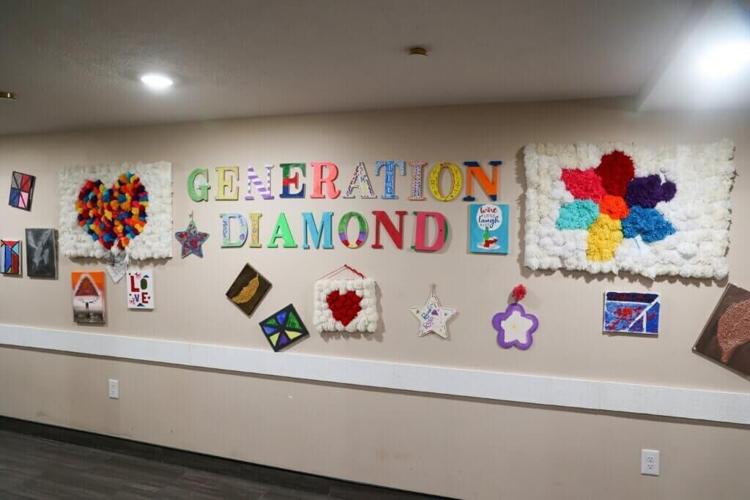
Located in South Omaha, Generation Diamond is one of just a handful of nonprofits nationwide that offer laser tattoo removal free of charge. Its clients are often justice-involved individuals looking to make a fresh start.
People are also reading…
While the young man from Lincoln sat for his first tattoo removal treatment, Generation Diamond’s founder, Blanca Mejia, explained that his plight is common. “A lot of our participants say, ‘I made a mistake one Saturday night. I was stupid. I was not thinking,’ and then regret their decision the next day.”
While many people get tattoo removal at Generation Diamond to boost their job prospects, that is far from the only reason. For some, a tattoo may trigger dark memories from a chapter of life that they would like to forget. Others may want to remove a tattoo signifying a gang affiliation. Still others may have been victims of trafficking—many of whom are “branded” with an identifying mark by their captors. In that case, keeping the tattoo may put them in danger of being put back into trafficking.
Making a costly service accessible
“We have a special program that focuses on re-entry,” said Juan Valey, chief operating officer at Generation Diamond. “These are guys that have just been released from incarceration, and we want to give them as much support as possible as they reintegrate into society. These are guys that have nothing.”
For someone in these life circumstances, paying to remove a tattoo is not a realistic option.
“It takes anywhere from 8-12 treatments to fully remove a tattoo, with six weeks in between each treatment,” said Mike Reilly, Generation Diamond’s assistant tattoo removal coordinator. “So, you’re looking at a year to a year-and-a-half [for the removal] depending on how your body responds, the type of ink used, the colors, etc.”
In the private sector, each treatment would cost about $150, Mejia said. Assuming eight sessions to remove a tattoo, that equates to $1,200. For someone who has recently re-entered society, saving enough to pay for the service could take years.
A unique, in-demand service
As founder of Generation Diamond, Mejia raises funds to ensure the nonprofit has the financial resources it needs to operate. In 2019, she approached potential donors who declined their support because they felt that Generation Diamond was duplicating services available elsewhere. They encouraged her to focus on developing something unique.
A nudge from her son, Daniel, then a student at Creighton Preparatory School, put her on a path to finding a distinctive service for Generation Diamond to offer. “He said, ‘Mom, we are learning about a similar program [to Generation Diamond] that is in another part of the United States. You should go and check it out,’” Mejia recalled.
She took his advice and went. The organization she visited had a tattoo removal program. Mejia was fascinated by it. She learned all she could about tattoo removal machines and how they worked.
At that time, Generation Diamond had unused funding because the coronavirus pandemic had limited in-person programming. Mejia called donors to ask what they wanted to do with their unspent contributions. They trusted her to do what she thought was best, and she used the funds to purchase a second-hand tattoo removal machine.
“Five years later, we have a waiting list of people from Grand Island, Lincoln, and the correctional facility in Tecumseh,” Mejia proudly said. In 2025, Generation Diamond provided laser removal service to 253 unique participants.
Generation Diamond recently purchased a top-of-the-line laser tattoo removal machine, using grant funding from the Nebraska Department of Economic Development. The new machine has improved the efficiency of tattoo removal services at Generation Diamond’s facility. Meanwhile, the nonprofit worked with the State of Nebraska to move its older machine into Omaha Correctional Center. Now, Generation Diamond goes there twice a month to provide tattoo removal services to inmates. “Over there, we have a waiting list of 200 people,” Mejia said. “Ultimately, our plan is to have tattoo removal available in every prison in Nebraska.”
Diamonds in the rough
“The name is Generation Diamond because I believe that each participant is a diamond in the rough, and they need us to make sure that they shine,” Mejia said.
Established in 2016, Generation Diamond opens its doors Monday through Thursday to assist people who lack stable employment, housing, or access to food. The nonprofit is especially active in assisting people who have been involved with the justice system as they re-enter society.
“When they have been incarcerated for a long time, they may not have credit, family support, or anything,” Mejia said. “Our purpose is to help them start again.”
Generation Diamond is the first place many people in metro Omaha go after being released back to the general population.
“Once they come here, they start out with a backpack full of personal health products and clothes (three or four shirts, three pairs of blue jeans, and steel-toed boots),” said Valey.
Generation Diamond also has a refrigerator stocked with snacks, sandwiches, and water bottles at all times to provide free nutrition to participants.
On average, Generation Diamond serves 70-80 individuals per day. Case managers meet with each participant to establish trust and build a relationship. Through this process, they determine the participants’ needs and can direct them to available programs and resources. Career support specialists then help participants obtain the documentation needed for employment and connect them to employers.
“It’s such a privilege to come to work every day and witness the positive change that is being made in our participants' lives as they progress in their reentry journey,” said Marina Rosado, Generation Diamond’s new executive director. “We are all proud to be a part of that journey."
Providing hospitality and hope
At Generation Diamond, there is a strong sense of belonging. “We make sure people feel like a family,” Mejia emphasized.
When touring the facility, participants were quick to volunteer their gratitude for Generation Diamond’s support.
“It has helped me out a lot. I went from homelessness to a house, to interning trying to get back into work, and they helped with clothing,” a female participant testified. “They are a big, positive influence to people around here. Even though I am stable, I still come and donate time. I want to come and give back.”
“This is a good spot for homeless people, or people who come from shelters or institutions, to come and reconnect with each other,” said a male participant. “Sometimes, in places like this, people come in and have to remind each other to stay focused. [Blanca] has helped us a lot, as far as classes, meals, and just giving us hope. [Generation Diamond] is also a place to help other homeless people. Just because I’m homeless, it doesn’t mean I can’t help the next homeless person. Any [blessing we do get], we share it with others. I like this place. You feel welcome and hospitality here.”


