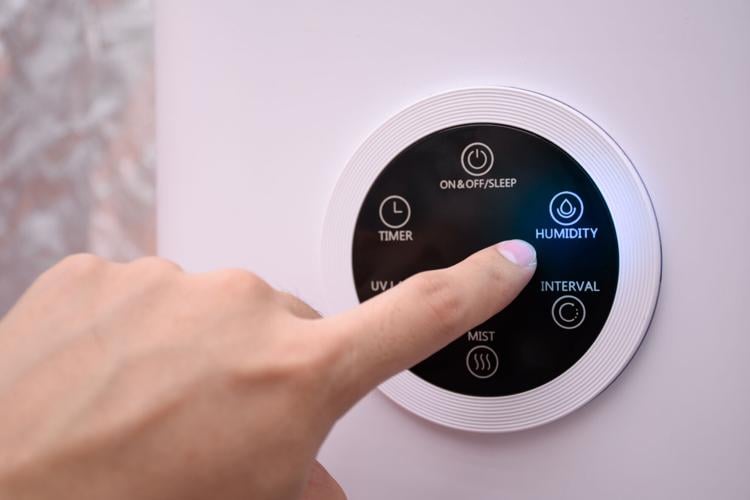



Close up man hand pressing the digital humidifier button on a smart humidifier in a smart home or green house.
If you make a purchase after clicking on links within this article, Lee Enterprises may earn affiliate commissions. The news and editorial departments had no role in the creation or display of this content. All opinions and views are of the advertiser.

When the furnace goes out at midnight or the AC quits in July, ARS/Rescue Rooter is the call to make
- 24/7 emergency service: HVAC Emergencies Don't Keep Business Hours
- All makes and models: Furnaces, heat pumps, AC, ductless -- they work on it all
Upfront estimates · Licensed & insured · Serving greater Omaha and surrounding areas
You know that feeling in late July when you walk inside and the house just feels heavy? The AC is running. The thermostat says 72. But something's off and you can't quite put your finger on it.
Nine times out of ten, it's the humidity.
Indoor moisture is one of those things that sneaks up on homeowners, especially in this part of the country. Wisconsin, Illinois, Indiana, the whole region sits in a climate belt that delivers genuinely brutal summer humidity. What happens to that air once it gets inside your house is something most people don't think about until a door won't close right, or there's a smell in the basement, or the AC stops keeping up and nobody can figure out why.
ARS/Rescue Rooter put together a solid guide on ways to manage indoor humidity that's worth bookmarking before summer gets going in earnest. Some of it is simple stuff. Some of it points toward a larger conversation about what's actually happening in your home.
Your AC is not a dehumidifier. Sort of.
This is the part that tends to surprise people. Air conditioners do pull some moisture out of the air as a byproduct of cooling. But if your home has a genuine humidity problem, the AC is the wrong tool for it. It's like using a shop vac to mop a floor. You'll get some of it but not really the point.
A system that's working twice as hard trying to compensate for heavy, moisture-laden air is a system that wears out faster than it should. HVAC humidity problems have a way of looking like mechanical problems at first. Coils that freeze up. A unit that runs constantly without the house ever feeling right. Short cycling. These get diagnosed as equipment issues when the real issue is the air the equipment is trying to condition. That's the frustrating version of HVAC breaking because of humidity: by the time it's clearly a mechanical failure, it didn't have to get there.

window with water drops closeup, frame inside, selective focus
The signs that are easy to explain away
Condensation on the windows in the morning. A musty smell you've mostly stopped noticing. Paint that's starting to separate from the wall in one corner of a room. Floors or cabinets that have gotten creaky in the last year or two. Individually these feel like minor annoyances or just the character of an older house.
They're usually not. They're the same underlying problem surfacing in different places. ARS/Rescue Rooter has a useful breakdown of the specific signs that point toward actually needing a dehumidifier rather than just living with it. A few of them are things most homeowners would recognize immediately once they saw them listed.
What actually fixes it
A whole-home dehumidifier integrated into your existing HVAC system handles moisture as its own separate job, rather than asking the AC to do two things at once. The practical effect is a house that feels comfortable at a higher thermostat setting, which usually means lower energy bills, and an AC that isn't running itself ragged against air it can't quite get ahead of.
The sizing matters more than people realize. A portable unit from a big box store is designed for a single room with a moderate problem. A whole-home dehumidifier system is sized against the actual square footage and humidity load of your specific home, and it ties into the ductwork so the whole house benefits rather than just one corner of the basement.
Don't forget February
The other end of the problem doesn't get talked about enough. Midwest winters are dry in a way that's hard on wood floors, furniture, respiratory systems, and anyone who wakes up with a scratchy throat from October through March. The same whole-home system that pulls moisture out in summer can be configured to add it back in during heating season.
Most people come to this conversation after something has already gone wrong. That tends to be the more expensive version.